Medical billing isn’t just about submitting claims and collecting payments. The way a billing operation is managed has a direct impact on denial rates, cash flow, and overall financial performance.
Some practices spend most of their time fixing denied claims after problems occur. Others focus on identifying issues before claims ever reach the payer. While both approaches involve claim submission, payment posting, and denial management, the results can be dramatically different.
As payer requirements become more complex and denial rates continue to rise across healthcare, especially among commercial and Medicare Advantage plans, practices can no longer afford to rely solely on reactive billing processes.
The difference often comes down to one simple factor: prevention.
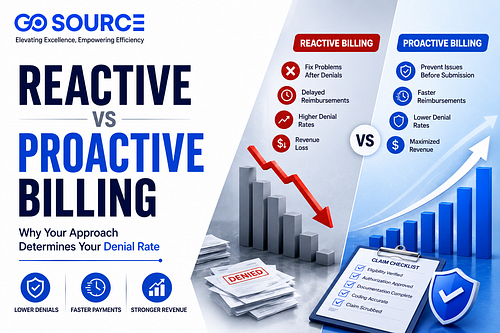
Reactive billing focuses on correcting problems after a claim has been denied. Proactive billing focuses on preventing those problems before submission. Over time, that distinction can significantly affect reimbursement speed, administrative workload, and revenue collection.
In this blog, we’ll explore the differences between reactive and proactive billing, how each approach impacts claim performance, and why prevention has become one of the most effective strategies for reducing denials and protecting revenue.
See how outsourced medical billing compares to in-house teams in cost, accuracy, and revenue performance — Read More here.
What Does Reactive Billing Look Like?
Reactive billing is the approach many healthcare organizations follow without intentionally choosing it.
The process is straightforward. Claims are submitted, payments are received, and denied claims are worked as they appear. When a denial arrives, the billing team investigates the issue, corrects the claim, and resubmits it. If the appeal is successful, the revenue is recovered. If deadlines are missed or the denial cannot be overturned, the revenue may be lost.
The challenge is that reactive billing addresses problems only after they have already disrupted the revenue cycle. While staff members spend time fixing denied claims, the same underlying issues often continue to affect newly submitted claims. As a result, denial patterns repeat month after month.
This doesn’t mean billing teams aren’t working hard. Most teams are doing everything possible with the processes available to them. The problem is that reactive workflows focus on correction rather than prevention.
As denial rates increase and payer requirements become more detailed, relying heavily on appeals and claim corrections creates additional pressure on staff and cash flow. Every denied claim requires extra labour, delays reimbursement, and increases the risk of missed filing deadlines.
The financial impact can be significant. Denials increase administrative costs, slow collections, and create unnecessary rework. More importantly, time spent correcting avoidable errors takes attention away from higher-value activities such as patient communication, authorization management, accounts receivable follow-up, and long-term process improvement.
At its core, reactive billing keeps a practice focused on fixing yesterday’s problems instead of preventing tomorrow’s.
What Proactive Billing Looks Like?
Proactive billing takes the opposite approach. Instead of waiting for denials to occur, it focuses on identifying and resolving issues before claims are submitted.
The goal is simple: prevent revenue disruption before it happens.
At Scheduling
The first opportunity to prevent denials occurs when an appointment is scheduled.
A proactive billing team verifies whether prior authorization is required and begins the authorization process immediately. Rather than addressing authorization requirements at the last minute, they become part of the scheduling workflow. This helps prevent authorization-related denials and supports faster reimbursement.
At Registration
Insurance coverage can change frequently, which is why proactive billing teams perform real-time eligibility verification on the day of service.
Even if insurance was verified days earlier, there is no guarantee that coverage remains active. Confirming eligibility at registration allows staff to identify coverage issues, update insurance information, and prevent denials related to inactive plans or incorrect payer details.
During Charge Entry
Before claims are created, documentation is reviewed to ensure it supports the services being billed.
This process helps confirm that coding accurately reflects the clinical record. If documentation is incomplete or unclear, the issue can be addressed before submission rather than weeks later through a denial. This reduces coding errors, documentation-related denials, and costly rework.
During Claim Scrubbing
Claim-scrubbing processes help identify errors before claims leave the practice.
Automated tools and manual reviews check claims for coding inconsistencies, missing modifiers, eligibility issues, and payer-specific edits that could result in denials. By catching these problems early, practices improve first-pass claim acceptance rates and reduce appeal volume.
Through Ongoing Denial Analysis
Even high-performing billing operations experience denials. The difference is how they respond.
Instead of simply correcting individual claims, proactive billing teams analyse denial trends and identify recurring patterns. Repeated denials may reveal payer-specific rules, documentation gaps, coding issues, or workflow weaknesses that require long-term solutions.
Over time, denial data becomes a valuable tool for continuous improvement and denial prevention.
Ultimately, proactive billing is about building systems that stop problems before they affect revenue. The result is fewer denials, faster payments, stronger cash flow, and a more efficient revenue cycle.
The Measurable Difference Between Reactive and Proactive Billing
The impact of billing strategy becomes clear when examining revenue cycle metrics.
One of the most important measurements is the first-pass claim rate, which reflects how many claims are paid correctly on their initial submission. Reactive billing environments often experience first-pass rates between 75% and 85% because issues are discovered only after denials occur. Proactive billing operations frequently achieve rates above 95% by addressing errors before submission.
Denial rates show a similar contrast. Practices operating reactively can experience denial rates of 15% or higher. By combining eligibility verification, authorization tracking, claim scrubbing, and denial analysis, proactive billing teams can often reduce denials to below 5%.
The benefits extend beyond denials alone. Fewer rejected claims mean fewer payment delays, resulting in lower Days in Accounts Receivable (AR). Clean claims move through the reimbursement process faster, helping practices maintain healthier cash flow and reduce outstanding balances.
Net collection rates also improve. Reactive billing often results in missed appeal deadlines, unresolved denials, and unpaid balances that reduce overall collections. Proactive billing focuses on preventing those revenue leaks and maximizing reimbursement opportunities.
Simply put, proactive billing improves efficiency, accelerates collections, and allows staff to spend more time supporting patients rather than correcting preventable billing mistakes.
Why Most Practices Still Operate Reactively?
If proactive billing delivers such strong results, why do many practices remain reactive?
The answer is largely operational.
Proactive billing requires planning, consistent workflows, staff training, performance monitoring, and the right tools. Reactive billing often develops naturally when teams focus primarily on submitting claims and responding to issues as they arise.
Most billing departments are already balancing claim submission, payment posting, denial management, and collections. With so many immediate responsibilities, preventive tasks often receive less attention than they deserve.
Unfortunately, this creates a cycle where recurring mistakes continue generating recurring denials.
Breaking that cycle requires a shift in perspective. Billing must be viewed as a strategic component of revenue management rather than a purely administrative function.
For some practices, this means redesigning internal workflows. For others, it means partnering with a revenue cycle management company that already incorporates denial-prevention strategies, automation tools, and proactive processes into its operations.
As payer requirements continue to evolve, more healthcare organizations are adopting proactive revenue cycle strategies to improve performance, strengthen compliance, and create greater financial stability.
How to Transition From Reactive to Proactive Billing?
The good news is that transitioning to proactive billing doesn’t require a complete operational overhaul.
The most effective approach is to identify where denials are being created and introduce prevention measures at those points in the workflow.
For many practices, the best starting point is real-time eligibility verification and prior authorization management. These two processes alone can eliminate a substantial number of preventable denials before services are delivered.
The next step is strengthening pre-submission claim review processes. Whether through automated claim-scrubbing software or manual quality checks, reviewing claims before submission helps identify coding errors, documentation issues, and payer-specific requirements before they lead to denials.
Finally, make denial analysis a routine part of revenue cycle management. Reviewing denial trends regularly helps uncover recurring problems, identify workflow weaknesses, and develop long-term solutions that reduce future claim rejections.
When organizations consistently prioritize prevention, denial rates decline, collections improve, and billing teams gain more time to focus on strategic revenue cycle activities.
The Takeaway
Your denial rate is not simply a reflection of how hard your billing team works. It reflects how effectively problems are identified before claims reach the payer.
In a reactive billing model, issues are discovered after denials occur, creating additional work, delayed payments, and potential revenue loss. Proactive billing focuses on identifying risks earlier in the process, allowing practices to prevent denials instead of constantly correcting them.
The financial benefits are substantial. Lower denial rates lead to faster reimbursement, healthier cash flow, stronger net collection rates, and reduced administrative burden. Even modest improvements in denial prevention can generate meaningful revenue gains over time.
The most successful healthcare organizations are no longer waiting for problems to appear before taking action. They are investing in processes, technology, and workflows that keep claims moving smoothly through the reimbursement cycle.
GoSourceMD takes a proactive approach to medical billing by combining AI-powered claim scrubbing, real-time eligibility verification, and early prior authorization management to identify potential issues before claims reach the payer. The result is fewer denials, faster payments, and a more efficient revenue cycle that helps practices protect the revenue they’ve already earned.
FAQs
What’s the most effective first step for moving from reactive to proactive billing?
Real-time eligibility verification on the day of service is one of the fastest ways to reduce denials. Insurance eligibility issues remain among the leading causes of claim rejections, yet many are preventable. Verifying coverage in real time helps identify inactive plans, coverage changes, and missing information before claims are submitted.
How long does it take to see results from proactive billing strategies?
Many practices begin seeing improvements within the first one to three months. Eligibility verification enhancements can reduce denials quickly, while claim-scrubbing and workflow improvements often produce measurable results within 30 to 60 days. Most organizations see significant denial-rate improvements within three to four months.
Can smaller practices adopt proactive billing without expensive technology?
Yes. Many proactive billing improvements are process-driven rather than technology-driven. Existing practice management systems often include eligibility verification tools, and simple workflow improvements can strengthen authorization management and claim review processes without major investments.
What financial impact can reducing denials have?
Reducing denials can significantly improve cash flow and collections. A practice with a high denial rate spends more time reworking claims and appealing denials, increasing administrative costs and revenue risk. Lower denial rates reduce rework, accelerate payments, and help practices collect a larger percentage of the revenue they earn.